
Snow days in schools
A policy idea to reduce the likelihood that snow will close schools

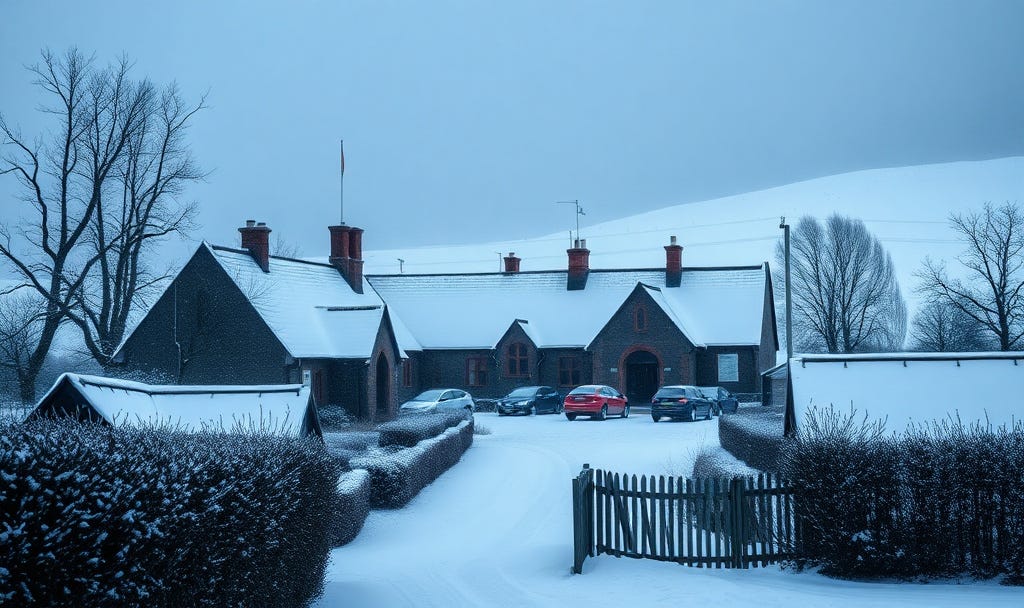
(AI picture of “English village school in snow”
(Nick Davies, Institute for Government Programme Director, tells me that this policy proposal was adopted in the Isle of Wight.)
It has been snowing in many parts of Britain recently. My London garden looked lovely with its light dusting of snow, but other parts of the country got a lot more of the white stuff: it stayed for a lot longer and it caused major disruption in some places. The BBC reported that more than 1000 schools were closed - including almost 100 in Staffordshire alone. Shutting schools is not something we want to happen more than is absolutely necessary.
Pupils typically live much closer to schools than their teachers do. Notably, in urban areas most primary school children live within walking distance of their school. Although secondary school pupils generally live further away, those who live in a town or city would usually be a bus or bike ride away. Children, in other words, can usually get to school.
In contrast many teachers wish to live a bit further away - they don’t want to bump into their pupils when they are off duty. That is why the most common reason for snow closures is that not enough teachers can get to their school. In London this will happen if the trains and buses are not running; outside London because it is not safe to drive. Indeed, at this time of year schools often ask their teachers how far away they live, and how long it would take them to walk to school if necessary. I know a number of teachers who live in my part of South West London who, if the trains are not running, would take three or four hours to walk to schools in central London. That is not realistic, and so the schools they work in have to close. The same is true for teaching assistants, office staff, lunchtime supervisors, and so on.
I know that some of the teachers in schools near me also commute a long way. A few come from inner London, many come from outside London. These schools also have to shut.
John Maynard Keynes once remarked “There is work to do; there are people to do it. Why not bring them together?” He was thinking about depressions, of course, but we can apply his remark to snow and schools. Today I am absolutely a Keynesian because I think we should match schools to the teachers who live nearby. Of course, some schools - particularly in inner London - will have too few teachers living near them, and would still have to close. But other schools would have enough teachers nearby, and they would be able to open more often.
Realistically, even if we do this, pupils will learn less than if the school was able to open normally. The children will not know the teachers, and the teachers will not know the pupils. Teachers will, in effect, be acting as supply teachers. But supply teachers are useful, and pupils do learn something from them. That is a good reason for doing this.
This idea will also have a second benefit - it will allow more parents to go to work. Of course, if the snow is heavy not all of them will be able to do so, but many will be able to go to work, or to work from home. As we found out during covid, it is really hard to work from home when you have a seven-year-old and a nine-year-old in the house. For that reason we should also prioritise opening primary schools, using local secondary teachers as necessary.
So there are two reasons for this policy. The first is to improve education, the second to raise national income by allowing parents to work in bad weather. Both are valuable, and the government should experiment with this idea to see whether and where it works. Within England I would start with Staffordshire, but of course Wales, Scotland and Northern Ireland are all disproportionately affected by snow - so the pupils in these places would benefit particularly if their governments decided to pursue this idea.
A nice idea, but I worry the organisational costs of getting such a system set up would outweigh the benefits in most areas of the country, given the infrequency of snow days.
Nice thought. Big logistical challenge, though. Made harder by parental choice - lots of children travelling to secondary schools from out of catchment, either driven by parents or using buses laid on by the school - and academisation. If everyone was still employed by the LA you could re-assign them easily but with them all working for different organisations you've got contractual and safeguarding information problems. There are also key people in a school. Where I'm a governor, lots of teachers and almost all support staff are local but the SLT including DSL and DDSL would be unable to get in if we ever have properly disruptive snow. I generally think we're a bit obsessed with safeguarding as a society and sometimes an extremely low risk prevents good things happening. However, running a school without leaders and with lots of unknown staff does strike me as a recipe for chaos, even if most likely no lasting harm.
In the end, snow days are rare. If they were common, then we'd all be able to get to work regardless. It's not a problem in Canada, Scandinavia, or the Alps.