
Self-driving buses
Faster, safer and needing less subsidy - what is not to like?

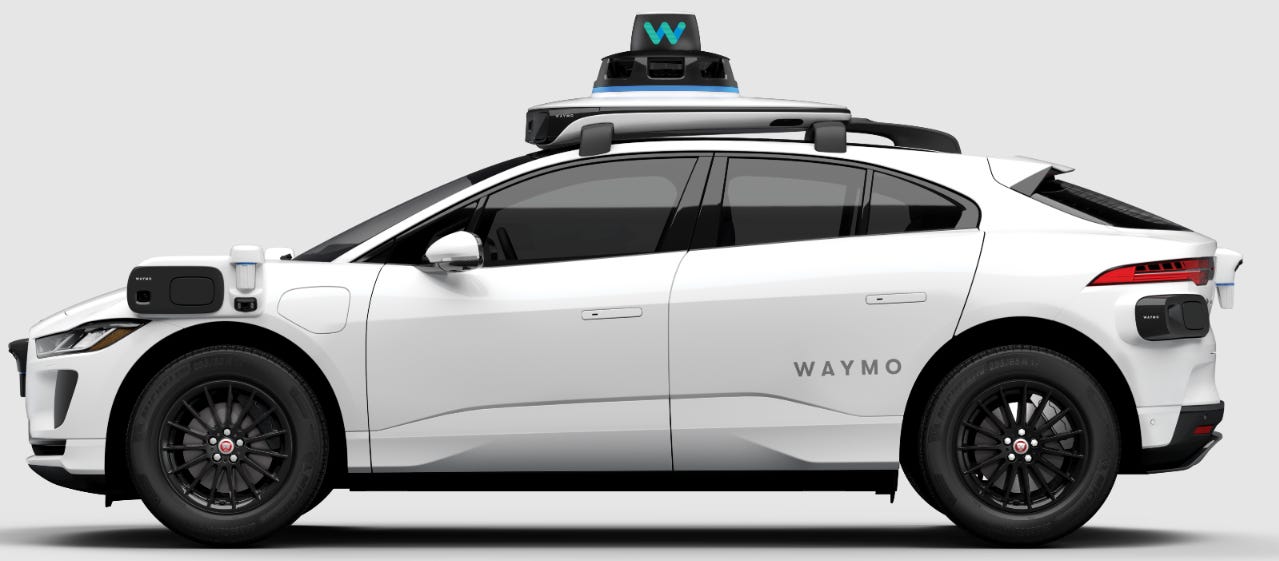
A Waymo self-driving car: I think it is ugly, but it is very effective. Source: Waymo, https://waymo.com/media-resources/
Last week’s policy idea proved to be so good that GWR are already doing it. They have a battery powered train that rapidly charges when stopped at stations, exactly as I was proposing. It is indeed cheaper to install than conventional overhead lines. So my revised policy idea is that the UK should roll out this approach steadily, because that is the most efficient and low-cost way to do these things.
When I was in San Francisco earlier this year I travelled in a driverless Waymo taxi. It was very impressive - smooth, considerate etc. Waymo have programmed them to run on every road in an area stretching from San Francisco to San Jose. That is hugely impressive, and I look forward to that happening here. In the meantime I have a policy idea - driverless buses.
My local bus, Kingston’s K2, covers a 7.5 mile route - 15 miles round trip. That is pretty typical for London - South London’s 59 is the same, for example. Of course, there are longer routes elsewhere, but there are also shorter routes - Doncaster’s 364 has a round trip of just 7 miles.
It is self-evidently easier to programme a driverless bus to travel on a particular 7 or 15 mile round trip that it will do over and over again, than to program a car to drive on any road in an area roughly 60 miles by 10.
My idea involves the driver becoming, or being replaced by, a conductor. This would make the buses faster, safer and perceived to be safer.
They would be faster not because the bus would drive more quickly, but because it would be faster to get on. At the moment everyone has to get on via the front door and tap to pay, or show some sort of pass. That is not as quick as just getting on, and particularly not as quick as being able to use both sets of doors to board. If there was a conductor, everyone could get on quickly, and then people would tap their cards on the conductor’s machine, once on board and moving - just like in the olden days.
It would be safer for passengers, both because the evidence is that driverless cars are exceptional well-driven, and because there would be a conductor on board reducing the risk of passengers committing crimes on each other. Of course, there is a driver at the moment, but there is little a driver can do to protect passengers, because they are driving the bus.
Finally, it would be seen to be safer because people would know that there is an employee on the bus, who can keep an eye on things.
If buses are faster, safer and perceived to be safer they will clearly attract more people. That is good news - because the costs of running a bus are the same pretty much however many people are on the bus. This is good news for taxpayers as well as passengers, because it means we can have better buses and lower taxes.
To be clear, I don’t think there would be any direct cost savings. Google tells me that London bus drivers earn £18-£20 an hour, which is not that much for a job that includes very early starts, late finishes and lots of weekend work. I would expect to pay about the same for conductors. In some ways my proposed job is easier than driving, in other ways harder.
A final reason why I think driverless buses are easier than driverless cars is that no-one really cares what a bus looks like. You can festoon it with radar, lidar and all sorts of detection equipment and no-one will think “I am not driving one of those”. Just look at the picture at the top - it will be a while people people are happy to buy cars that look like that.
Taken as a whole I am surprised that governments, councils and bus companies, in the UK and abroad, are not doing this. I hope that changes soon. Thankfully the UK is about to have a Prime Minister who is very interested in buses. Perhaps one of my readers might pass this along to him?
DLR in London is driverless I think (?). Seems to work OK!
if there are no economies of scale to vehicle size, it seems to me this tech implies that everyone should use driverless cars rather than driverless buses - higher load factors. Of course, there are economies of scale - mainly, as I understand it, that air resistance is almost a fixed cost, regardless of numbers of passengers. However, if buses were the optimal size before driverless EVs, then I expect buses will be too big in the future. So - I expect we should plan for driverless electric minibuses and for a greater diversity of routes, perhaps even variable routes.