
Reducing wasteful spending on our railways
Here is a rule that can go

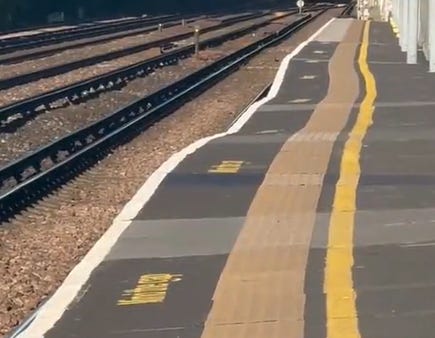
Berrylands Station, near my home in South West London, was built in the 1930s and is now falling down. The platforms are made of plywood covered in what I think is shed roofing felt. The platforms sit on wooden beams whose uprights are knocked into quite a steep railway embankment. After 95 years, the wood is literally rotting, the platform is sagging in lots of places (see the picture), and the station is beginning to slide down the embankment. Network Rail have, quite understandably, shut the station this summer. They will demolish the existing platforms and replace them with new ones. The video of the demolition shows how flimsy it all was (second video on this page).

Berrylands station is used by about 1000 people a day, making it busier than the average station, even if neighbouring Surbiton is twenty times busier still. The rules are clear - when a station is closed like this, Network Rail must provide a bus service in lieu of the train service. In this case the bus goes from Surbiton - the stop before - to Berrylands, and then on to New Malden - the stop after, before making the return journey. The bus takes about 12 minutes each way, and makes the journey every half an hour. The first bus leaves at 0538 and they run until 0109 departure the following morning. That is a lot of buses.
At first sight a rail replacement bus service seems sensible - except that no-one is using it. I have seen many of these buses in the last few weeks, and they are virtually always completely empty. I asked one of the drivers whether it was busier at rush hour, and he told me that it was never busy. In fact, he told me, he had done an entire eight hour shift one weekday, from 6am until 2pm, without picking up a single passenger. It was, he told me, the most boring job he had ever had.
Berrylands station serves two distinct communities. The first is Berrylands, to the south. These people are not using the new bus because there is a regular Transport for London bus (“the K2”) that already runs from Surbiton station to Berrylands station. The K2 has three advantages. First, it runs five times an hour rather than twice. Second, it coincides with the fast trains from London, while the new bus is scheduled to meet the slowest trains. Third, it stops in various places in Berrylands, not just at the station - so it is much more likely to stop near your house. Indeed, many people get off the train at Berrylands and take the K2 to their home. People prefer the K2 because it is faster and more convenient. Who would have guessed?
Berrylands station is also used by a few people who live in New Malden, to the east. For almost all these people it will be faster to walk from New Malden station to their home, rather than catching the new bus from New Malden to Berrylands, and then walking part of the way back again.
Providing this bus service cannot be cheap. The buses have come up from Portsmouth - they say “Solent” on the sides - and the drivers are being put up in hotels (2*, and terrible according to the driver I spoke to). As well as the driver, someone is employed at Surbiton station to stop people parking in the dozen or so car parking spaces that are being used as a bus stop and turning area.
My policy idea is obvious - we should get rid of the rule that says rail companies have to provide a rail replacement bus service in all circumstances. Such services are often useful, but in some cases - like this one - they are just a waste of money. My money, your money, everyone’s money.
With rules like this, no wonder railways are costing taxpayers about £12bn a year. Let’s try to spend money more wisely.
Who can disagree with this? ... people need to engage their brains before any new action rather than just following rules and policy blindly. Let's question the rules once in a while!
Tim - surely all that does is saves a private company money? Maybe now they're returning some companies to public ownership it would save us money. You'd have to make the company pay back an equivalent sum that they would have spent on the bus service for we taxpayers to benefit. Or are you saying the bus service is a direct result of the station problem which isn't a train operator problem, if so same question really, who is paying and who will save? Thanks