

The latest OECD-administered PISA education analysis is now available. Last year, around the world, many 15 and 16 year olds took standardised tests in reading, maths and science. Of course we can quibble about samples and so on (particularly for China) but this is the best measure of which countries actually teach children effectively.
World educational standards have fallen, but England (not Scotland, not Northern Ireland, not Wales) is a stand out success. “Visit England (and Estonia) and see what we do” would make a good substack.
But I found something more interesting, with much more profound policy implications. Falling global birth rates means rich nations’ future economic success increasingly depends on immigrants. Can a nation attract “good” immigrants? Can it educate immigrants that do arrive? Can it educate their children effectively?
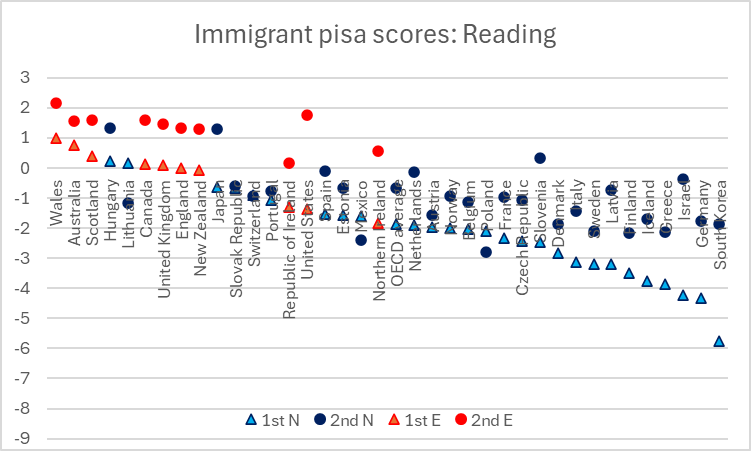
In the chart above the y-axis is “years of education equivalent”: 1 means a child is one year ahead, and -5 means they knew no more than someone who quit school aged 11, at the end of primary.
Look at Wales, on the left. The triangle says that first generation immigrants in Wales do better in PISA’s reading tests than native-born Welsh children - by about a year. The circle tells us that second generation immigrants in Wales do even better - they are two years ahead. Now look to the right. The triangle shows that first generation immigrants in South Korea are 6 years behind native-born South Koreans (effectively they don’t even complete primary school), and the circle shows that second generation immigrants are two years behind. Of course, immigrants in Wales don’t have to do that well to beat native born Welsh students, given appalling local results, while immigrants into South Korea would have to do spectacularly well to match local standards. And of course neither place has many immigrants. Don’t read too much into any individual dot.
Look instead at the colours. The red triangles average about zero, the blue about minus two. The red circles are a bit above one, the blue circles about minus one. In each case, red trumps blue by about two years. In short, immigrants do well in red countries, and badly in blue ones. The red countries are English speaking, the blue ones speak other languages. The reason is surely obvious - although English is not an easy language to learn per se, its global ubiquity means that people are more likely to know some before arriving, and find it is easier to learn after arriving.
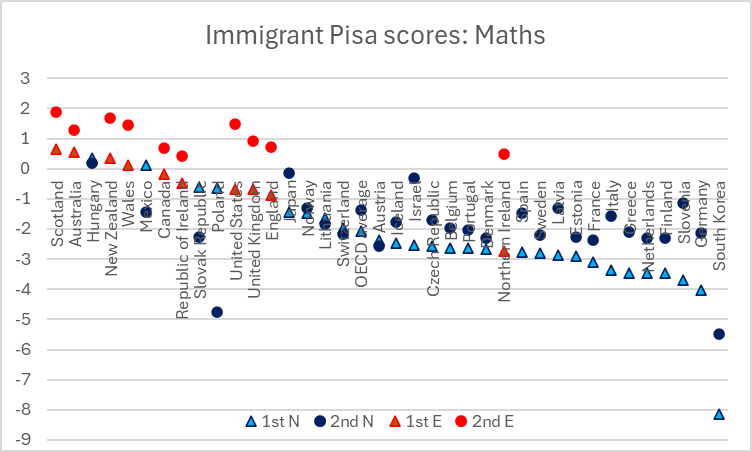
The evidence is even clearer in maths. Again, first generation immigrants to English speaking countries are on a par with natives, and second generation a year ahead. In contrast, first generation immigrants to non-English speaking countries are almost three years behind, and the second generation two years behind, a difference of three years rather than the two for reading. Fluency in the local language is critical in mastering abstract mathematical concepts explained in a classroom.
My recommendation, therefore, is both evidence-led and brutal. Non-English speaking countries should adopt English as a full-status local language, including offering English language or bi-lingual schooling as part of their local state-funded education systems. If they do, they will find it easier to attract “good” migrants, and all migrants - and their children - will do better in schools than would otherwise be the case. This will create a brighter economic future for their nations.
I do not expect my advice to be taken, which leads me to two further conclusions. First, future economic growth will be much faster in English-speaking countries than people expect, at least relative to other countries. We will attract the best migrants, and - as now - they will be highly successful in school, and therefore in the economy. Second, the UK will continue to have a “small boats” issue. Why on earth would a migrant - genuine refugee or not - want to stop in France? We offer them and their children a bright future, and France does not.
It's a striking graph but I'm not persuaded it really backs up the thesis. What's going on with the children of immigrants? They are native speakers.
(A minor point, and I seem to be fighting a losing battle on this, but - there's no such thing as a 'second generation immigrant'. I didn't immigrate to the UK, how can I be an 'immigrant'?)
That is a strong pattern. The successful education outcomes for children of immigrants in the UK (and Australia) are well known. It's been argued that this is the main cause of "the London effect" and there was a fascinating study done on PISA data showing that children of Chinese ethnicity did equally well in Shanghai and Australia, suggesting it was cultural and not the school system. However, I've not seen the anglophone theory before: interesting! My experience is that plenty of immigrants to the UK speak very limited English initially but make remarkable progress with language when they're in school and I don't see why that wouldn't be true in non-anglophone countries if immigrants are equally well-integrated. This makes me think it is either a well-established selection effect already, or Anglophone countries are consistently better at integration, or a bit of both.