
A proposal for bankruptcy
Every little - and not always little - helps

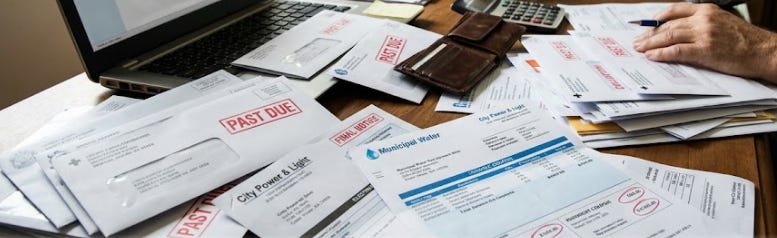
Thanks to Google Gemini AI for this picture of financial ruin…
Charlie Elphicke, the former Conservative member of parliament for Dover, was sentenced in 2020 to two years’ imprisonment after being found guilty of three counts of sexual assault against two women. The judge described Elphicke at his trial as a “sexual predator who used [his] success and respectability as a cover”. He has since been released from prison. The Sunday Times reported last week that when “asked whether he accepted his guilt in relation to the crimes for which he was convicted, Elphicke declined to respond.”
Elphicke sued the Sunday Times before, during and after his time in prison. He claimed that the paper “violated his human right to privacy and defamed him” - a stance he maintained even after he was found guilty. He withdrew his case at the last moment, and as a result was liable to pay the legal costs of the Sunday Times.
Except that he says he can’t pay, and has declared himself bankrupt. The Sunday Times will end up significantly out of pocket.
I have a policy idea that would improve this situation…
Thanks to Google Gemini AI for this picture of financial ruin…
Charlie Elphicke, the former Conservative member of parliament for Dover, was sentenced in 2020 to two years’ imprisonment after being found guilty of three counts of sexual assault against two women. The judge described Elphicke at his trial as a “sexual predator who used [his] success and respectability as a cover”. He has since been released from prison. The Sunday Times reported last week that when “asked whether he accepted his guilt in relation to the crimes for which he was convicted, Elphicke declined to respond.”
Elphicke sued the Sunday Times before, during and after his time in prison. He claimed that the paper “violated his human right to privacy and defamed him” - a stance he maintained even after he was found guilty. He withdrew his case at the last moment, and as a result was liable to pay the legal costs of the Sunday Times.
Except that he says he can’t pay, and has declared himself bankrupt. The Sunday Times will end up significantly out of pocket.
I have a policy idea that would improve this situation…
As the law stands, people who enter insolvency can keep personal effects - clothes, furniture, tools for a trade. Everything else has to go to their creditors - house, car, etc. That seems fair enough, except…
There are two assets they can keep. The first is their personal and employer pension. According to wikipedia, Elphicke worked in pharmaceuticals, and was a partner in two law firms. It is at least plausible that he has large pension pots from these earlier employments. In addition, he has his MPs pension. His 9 years of service will give him a House of Commons pension of approximately £18,000, indexed linked, when he reaches 65.
My first idea is that the House of Commons should follow the police, doctors etc, and have a rule that pensions are confiscated when the holder brings their employer into disrepute. Being sent to prison for two years for sexual assault would meet this standard. Parliament is one of the few public sector bodies that does not have this rule - that should change.
Second, however, the court should seize pension pots as a matter of routine. You have an asset, you owe money - why should you keep the asset?
I don’t know how much Elphicke owes. But I can imagine his earlier private pension pots would be sufficient to cover his debts. But if not…
The second asset that Elphicke has is his right to claim a full pension. He has almost certainly accrued the right to a full pension, given his work history. The UK government’s moneyhelper website tells me that, even with a ten year delay until it can be claimed, Elphicke’s state pension is worth at least £230,000 (based on RPI uprating, rather than the triple lock).
There is no reason why he, or any other bankrupt, should be able to keep this. My default is that it should go to his creditors - the government would make a payment in lieu. In truth I think that the allocation of the state pension should be for the judge to decide. We do not want to deter people from being entrepreneurs, but when the insolvency is caused by behaviour of which I imagine a judge would take a dim view, the value of the state pension should be available to the courts to allocate.
Elphicke would then start his pension accrual again. He is unlikely to be able to earn the right to a full pension given his age, but pension credit exists for those who find themselves with insufficient means in retirement.
The Sunday Times, like all good newspapers, does our country a favour by investigating and reporting facts. They should not be left out of pocket by a criminal who declares himself insolvent, but has significant pension assets. Nor, more generally, should the bankrupt be able to keep assets such as these. The government should change the law.